The first line decides
Picture a hiring manager on a Thursday afternoon with a cold coffee and 140 applications to get through before Friday. They open your cover letter. They read the first line.
That first line is doing more work than you think. If it sounds like the last forty letters, the eyes slide down the page, the brain switches off, and your carefully written third paragraph is never read.
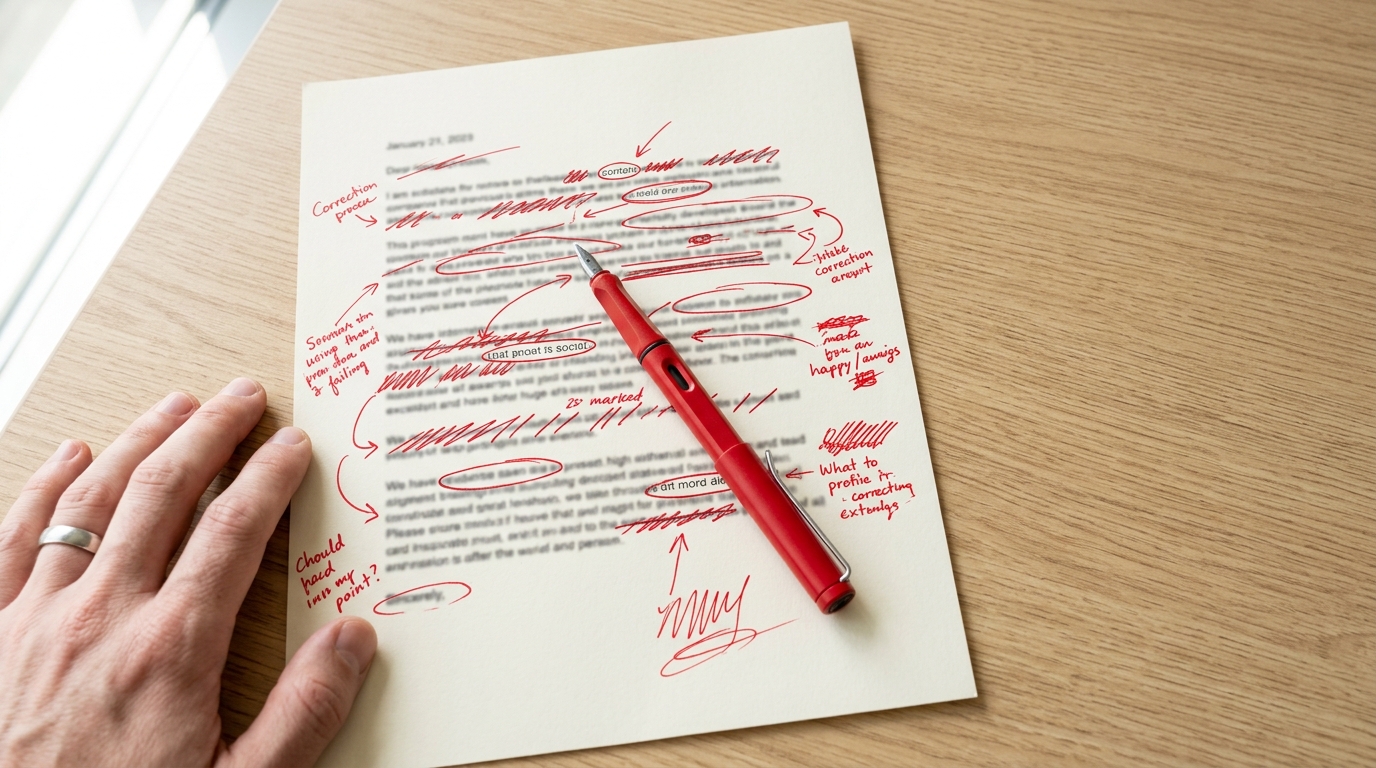
So let's do something useful. Below is a cover letter that's typical, polite and completely forgettable. We're going to take a red pen to it, line by line. Then we'll rebuild it for the very same job, to show how much a few changes can do.
Exhibit A: the letter that gets skimmed
Meet Daniel (a made-up example, but a very familiar one). He has three years of experience in customer service and is applying for a Customer Success Executive role at a software company. Here's his first draft, with red-pen notes after each line.
Line 1: "Dear Sir/Madam, I am writing to apply for the position of Customer Success Executive which I saw advertised online."
🔴 They know what you're applying for: you sent it to them. You've spent your most valuable line on information they already have. And "Sir/Madam" suggests you didn't look up a single name.
Line 2: "I am a hard-working, motivated team player with excellent communication skills."
🔴 Every applicant says this. Adjectives are claims, and claims are cheap. Where's the proof?
Line 3: "In my current role I am responsible for answering customer queries and resolving complaints."
🔴 This describes the job, not how well you did it. Were customers happier because of you? By how much?
Line 4: "I believe I would be a great fit for your company and I am passionate about customer service."
🔴 Which company? This sentence could be sent to anyone, so it says nothing about this one.
Line 5: "Please find my CV attached. I look forward to hearing from you."
🔴 A polite ending, but a passive one. There's no reason to act.
Nothing in Daniel's letter is wrong. That is exactly the problem. It's safe, and safe is invisible.
Nothing in the letter is wrong. That's exactly the problem. Safe is invisible.
Exhibit B: same person, new letter
Daniel didn't gain any new experience. He just stopped hiding the experience he had. Here's the rewrite.
Dear Priya,
Last year, I helped bring our team's average complaint resolution time down from four days to under 36 hours, and our customer satisfaction score rose 18 points as a result. I'd love to bring that same focus to customers at Brightloop.
Your advert mentions reducing churn in the first 90 days. That's the part of customer service I enjoy most: spotting the customer who's quietly struggling before they leave. In my current role, I started a simple check-in call for new accounts in their second week, which our manager has since rolled out to the whole team.
I've also been using Brightloop's free plan to manage my own projects, so I already know where new users get stuck, and I have a few ideas about it.
I'd welcome a short call to talk about how I could help your onboarding numbers. My CV is attached with the full details.
Best wishes, Daniel

What changed: three rules
1. Lead with your best evidence, not your intention. The first line now delivers a result with numbers. The hiring manager has a reason to keep reading before they've finished the first sentence.
2. Mirror their problem, not your wish list. Daniel found the challenge in the job advert (early churn) and showed he has already worked on it. The letter is now about what they need.
3. Prove you picked them on purpose. A name instead of "Sir/Madam". A mention of their product. A detail that couldn't be copied and pasted into another application.
A cover letter isn't a summary of your CV. It's the answer to one question: why you, for this job, at this company?
The catch: doing this for every application
Rewriting one letter like this is satisfying. Rewriting one for every role you apply to, each with the company's own problem, language and details, is where most people give up and go back to "Dear Sir/Madam."
That's the gap the Jobcus Cover Letter tool fills. Paste in the job advert, and it builds a first draft around that specific role: what the employer is asking for, matched with evidence from your own experience. You still choose the stories and polish the tone. It just removes the blank page, so every letter starts from Exhibit B instead of Exhibit A.
Because Jobcus keeps your work in one place, the letter can draw on what you've already done there. If you've built your CV in the Resume Builder, your achievements are ready to use. If you've checked a role with the Resume Analyzer, you already know which strengths that employer cares about most, so you know what to lead with.
The blank page is where good applications go to die. Start from a draft, then make it yours.
Try the red pen on yours
Open the last cover letter you sent. Read only the first line. Ask yourself honestly: could forty other applicants have written it?
If the answer is yes, you now know exactly what to fix. Lead with proof. Mirror their problem. Show you chose them.
Or skip the blank page altogether. Paste the next job advert you're excited about into the Jobcus Cover Letter tool, and see what your Exhibit B could look like.