
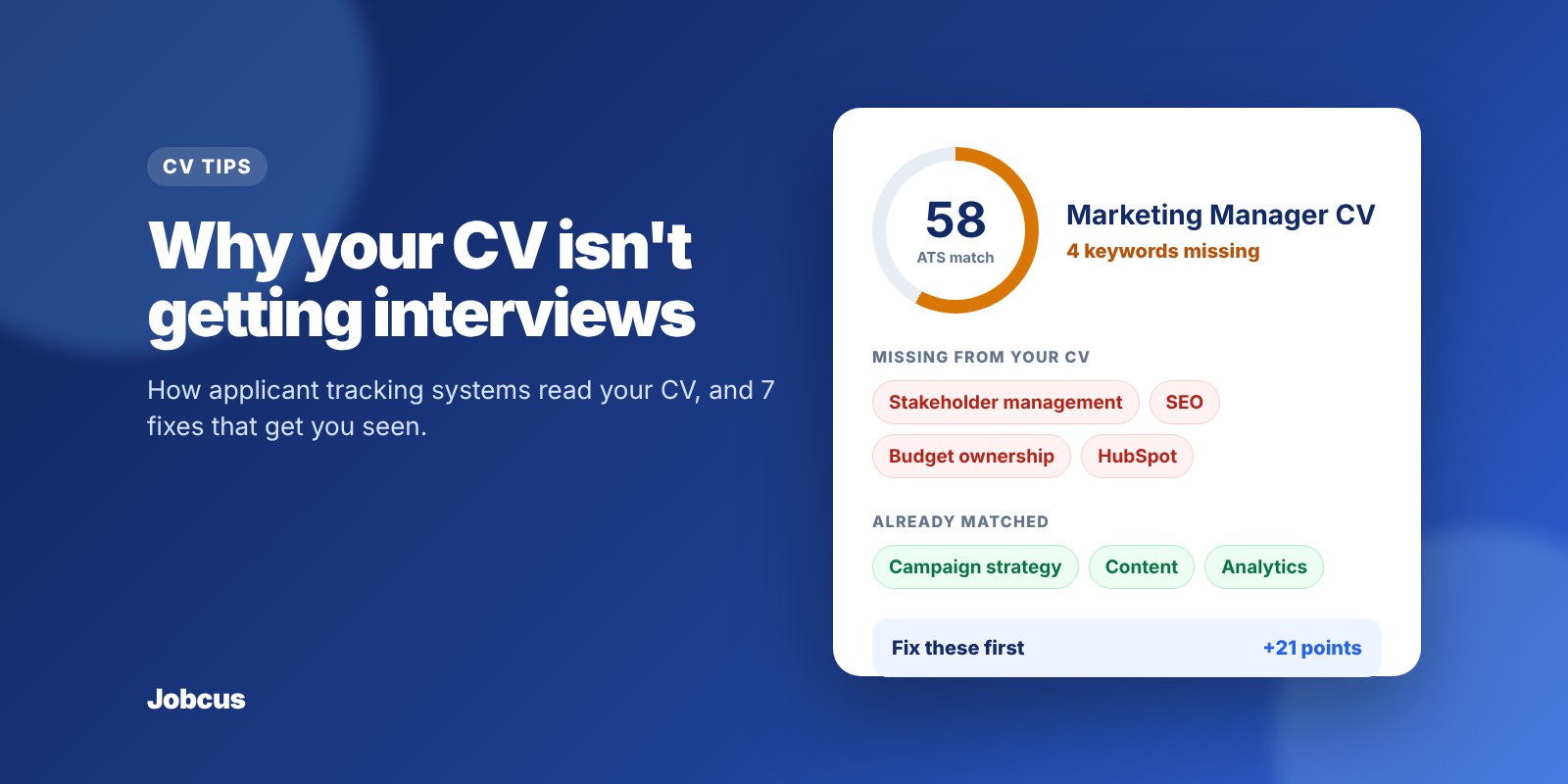
You've found a role that fits. You tailor your cover letter, press apply, and then nothing. No interview, no rejection, just silence. Do that twenty times and it's easy to decide the problem is you.
Usually it isn't. More often, the problem is that your CV isn't saying what the employer is looking for, in a way their software and their recruiters can quickly see.
How applicant tracking systems read your CV
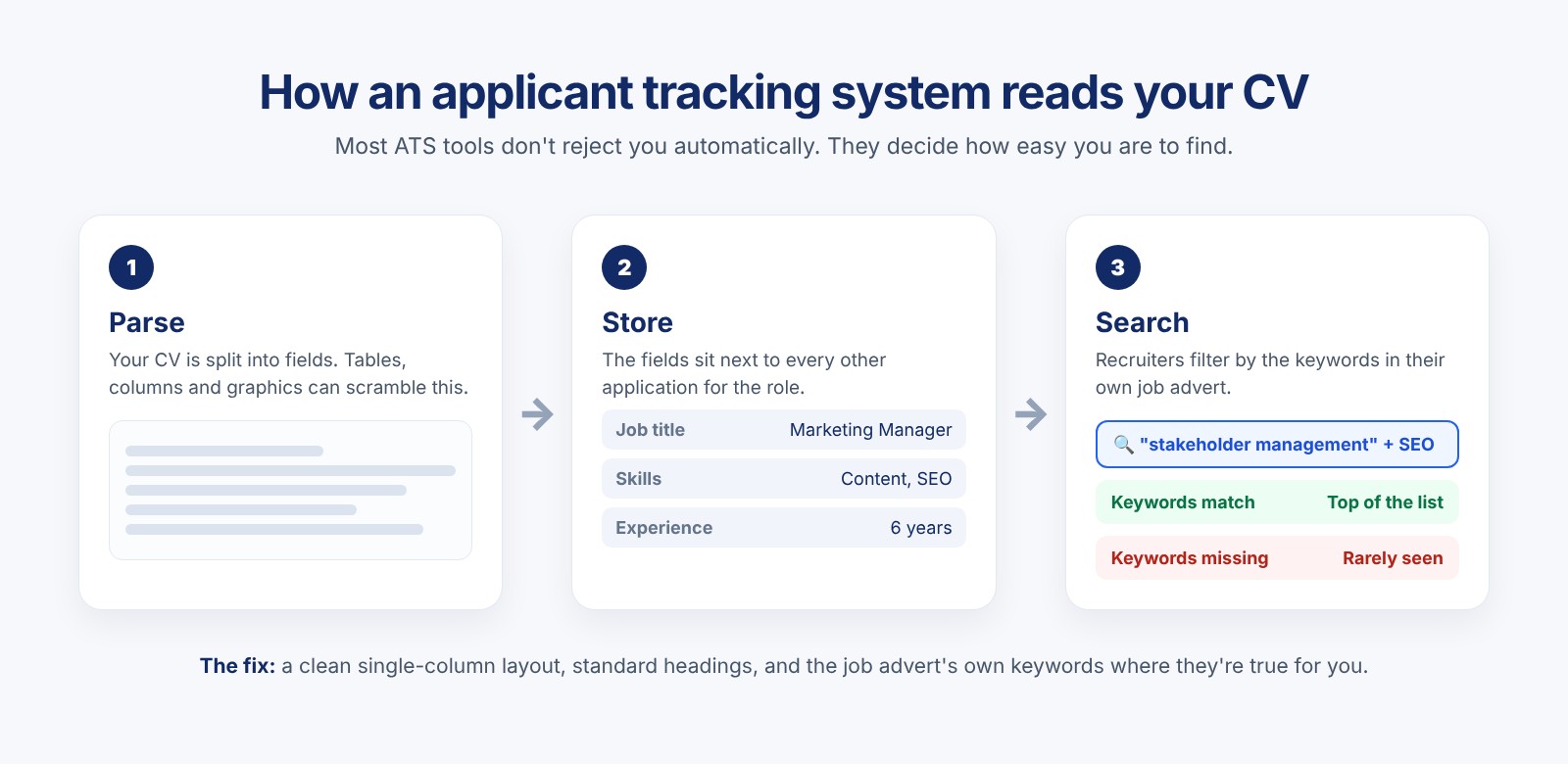
Most medium and large employers use an applicant tracking system (ATS) such as Workday, Greenhouse, Lever or iCIMS to manage applications. When you apply, the ATS:
- Parses your CV into fields like job titles, employers, dates, skills and education.
- Stores it alongside every other application for the role.
- Lets recruiters search and filter applicants, often by keywords, skills, location or years of experience.
You may have heard that "75% of CVs are rejected by robots". That figure has no reliable source. Most ATS tools don't automatically bin your CV. What they do is decide how easy you are to find. If a recruiter searches for "stakeholder management" or "SQL" and your CV doesn't contain those words, or the system couldn't read the section they were in, you won't show up near the top. With hundreds of applicants, the bottom of the pile is where good candidates go unseen.
7 reasons your CV isn't getting interviews
It's missing the keywords from the job description
Recruiters search for the skills and job titles in their own advert. If the job asks for "project management" and your CV says "ran projects", a keyword search can miss you. Mirror the exact wording of the role where it's honestly true for you.
The layout confuses the parser
Text boxes, tables, columns, icons and skills shown as graphics can scramble the parsed result. Your experience may end up in the wrong field, or vanish. A clean single-column layout with standard headings (Experience, Education, Skills) is read most reliably.
Your job titles don't match what people search for
Creative or internal titles like "Customer Happiness Ninja" won't match a search for "Customer Service Advisor". Keep your real title, and add the standard equivalent in brackets if they differ.
It lists duties instead of results
"Responsible for social media" tells a recruiter what was on your job description. "Grew Instagram followers from 2,000 to 11,000 in 9 months" tells them what you achieved. Start bullets with a strong verb and add a number wherever you can.
It's one CV for every job
A general CV is a compromise for every role. Small changes for each application, like reordering skills, adjusting your summary and moving your most relevant achievements up, make a big difference to how well you match.
Key details are hard to find
Recruiters often skim a CV in seconds. If your most relevant experience is on page two, or your summary is a paragraph of clichés, they may move on. Put your strongest, most relevant evidence in the top third of page one.
Spelling, dates and contact details
Typos, unexplained gaps without context, and an old phone number or email still cost interviews. Check every detail before you apply.
How to check your CV before you apply
You can do a rough check yourself:
- Copy the job advert into a document and highlight the skills, tools and qualifications it mentions.
- Check how many of them appear in your CV, worded the same way.
- Save your CV as plain text and read it. If the order looks jumbled, an ATS may see it that way too.
Or you can let a tool do it in about a minute.
Get a free CV score with Jobcus
The Jobcus resume analyzer reads your CV the way applicant tracking systems do and gives you an ATS-style score. Add the job you're applying for, and it shows:
- Your match score for that role
- The keywords and skills you're missing
- What to fix first, ranked by impact
When you're ready, the AI resume builder can rewrite your CV for that specific role, and you can track every application in your Career Hub.
Your CV doesn't need to be perfect. It needs to make it easy for the right employer to see you're a fit.
Frequently asked questions
Do all employers use an ATS?
Not all, but most medium and large employers and many recruitment agencies do. Small businesses may read every CV by hand. Either way, a clear, keyword-matched CV helps both software and people.
Should I make my CV plain to pass an ATS?
Simple, not boring. Use a clean single-column layout, standard headings and a readable font. You can still use a little colour and good spacing.
How long should my CV be?
Two pages is standard in the UK for most roles. One page is fine early in your career. Senior or academic CVs can run longer if every section earns its place.
Is the Jobcus CV score free?
Yes. You can upload your CV and get a free ATS-style score and missing-keyword report at jobcus.com.
